
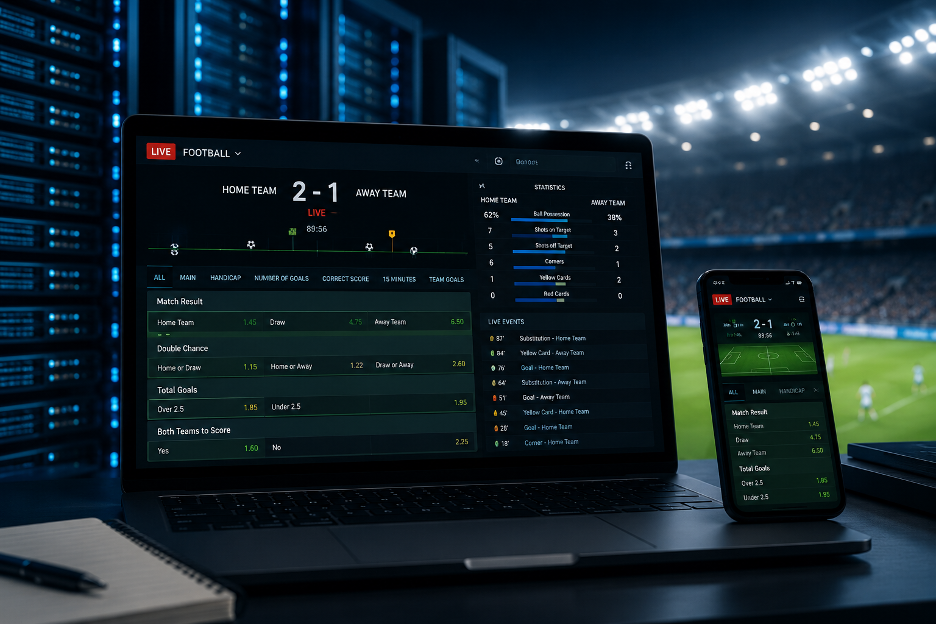
During the final minutes of a high-stakes football match, betting markets can move several times within a single minute. Whether you are navigating a specialized World Cup betting site during a major international final or backing a local league game, a single goal, penalty decision, or VAR review triggers immediate changes across dozens of markets. What appears on a screen as a simple odds adjustment is actually the result of a massive, high-speed data operation taking place behind the scenes.
Modern sportsbooks rely on real-time data feeds to keep pace with the speed of live sport. These feeds deliver information from stadiums, leagues, and official data partners directly into trading systems that continuously monitor and update betting markets. As live betting has become a larger part of the industry, access to fast and reliable data has shifted from a competitive advantage to a basic operational requirement.
What Happens Between the Field and the Betting Market?
Sportsbooks aren’t just selling lines; they’re trying to survive in a chaotic, high-speed ecosystem where the house edge can vanish in a heartbeat. Think about that 89th-minute goal or a messy, drawn-out VAR review; the board doesn’t just “shift”; it goes into overdrive, forcing a total recalculation before anyone can catch their breath.
Keeping the lights on in this environment means you’re at the mercy of the data feed. Operators aren’t doing this alone; they’re piggybacking off giants like Sportradar or Genius Sports to pipe live, granular stats straight from the pitch into their trading engines. The days of traders manually clicking away at a screen are pretty much dead. Now, it’s all about the algorithm’s reaction time.
Why Sportsbooks Pay Attention to Latency
Latency remains one of the most discussed topics among sportsbook technology teams. The term refers to the delay between an event occurring and that information becoming available on a betting platform.
The challenge is most obvious during high-stakes football matches, where punters locking in a live bet expect the odds on their mobile screens to react instantly to a sudden counter-attack or a yellow card.
Even a short delay can create operational challenges. Trading teams may need to suspend markets, adjust prices, or manage exposure while new information is being processed. The faster those updates arrive, the easier it becomes to maintain accurate betting markets.
The Shift Toward Automated Trading
The old image of a trading room full of people adjusting odds by hand is largely a myth in today’s high-stakes market.
Modern trading is now dominated by automated systems. These platforms ingest thousands of data points every single minute, including possession stats, shot locations, disciplinary action, momentum shifts, and updated odds in real-time. Human traders still set the strategy, but the execution? That’s pure automation. It allows for a level of scale and accuracy that would be impossible for any human team to replicate.
The Technology Most Users Never Notice
Beyond just pricing, these feeds are fundamentally changing the look of betting apps.
Top-tier sportsbooks are now morphing into comprehensive digital arenas. They’ve moved way past just showing a list of numbers. Now, you get live match trackers, visual game maps, and real-time player performance metrics. The strategy is simple: keep the user in the ecosystem. By wrapping betting markets in rich, live data, operators turn a simple wager into an immersive, all-day entertainment experience.
The Bottom Line
The modern sportsbook is defined by what happens under the hood. It’s a relentless chain of collection, transmission, and lightning-fast analysis. As the industry continues to chase more engagement and more “in-play” volume, the quality of that data plumbing will remain the most critical factor separating the market leaders from the rest of the pack.

